
Methods
Classical models.
Classical models.
Stated limits.
Full equations, assumptions and references ship with the app.
Stack-up
Ring model per layer. Worst case with corner search, RSS, modified RSS, Latin-hypercube Monte Carlo. Cp/Cpk, normal or ISO 22514-2.
Mechanics
Laminate theory for braids and coils. EA, EI, GJ, yield burst with netting, Bresse collapse, Brazier kink, Euler column.
Steering
Pull-wire moment on the full section stiffness, capstan friction, checked against a MuJoCo rod within 1 % to 180°.
Validation
Four layers of tests.
01
Exact maths
Textbook limits reproduced.
02
Trends
Braids, coils, offsets.
04
Published data
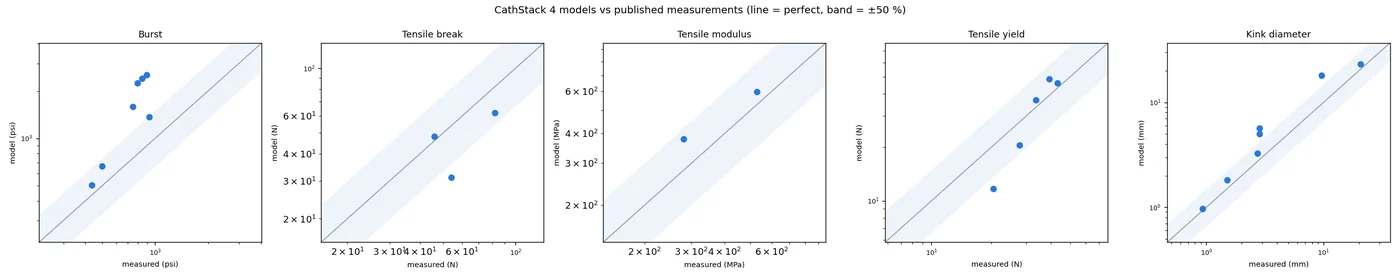
~30 points, 7 sources.
Model vs measured
Where it stands.
| Model | Model / measured |
|---|---|
| Bending vs braid angle | 2–4 % |
| Torsion vs braid angle | 1 % |
| Tensile yield, coil shafts | 0.57–1.23 |
| Kink diameter | 1.04–2.0 |
| Burst, plain tubes | 1.15–1.33 |
| Burst, open braid | 1.5–2.9 |
Limits, plainly.
- Engineering estimates: trends are reliable, absolute burst, kink and break need test.
- Absolute stiffness is checked for order of magnitude only.
- Correction factors let you calibrate to your own tests; the report lists them.
- Not a validation record. For regulated use, validate under ISO 13485 §4.1.6.
References
- R. M. Jones, Mechanics of Composite Materials, 2nd ed., 1999.
- S. P. Timoshenko, J. M. Gere, Theory of Elastic Stability, 2nd ed., 1961.
- L. G. Brazier, Proc. R. Soc. Lond. A 116 (1927).
- W. C. Young, R. G. Budynas, Roark's Formulas for Stress and Strain.
- ISO 22514-2, process capability and performance.